
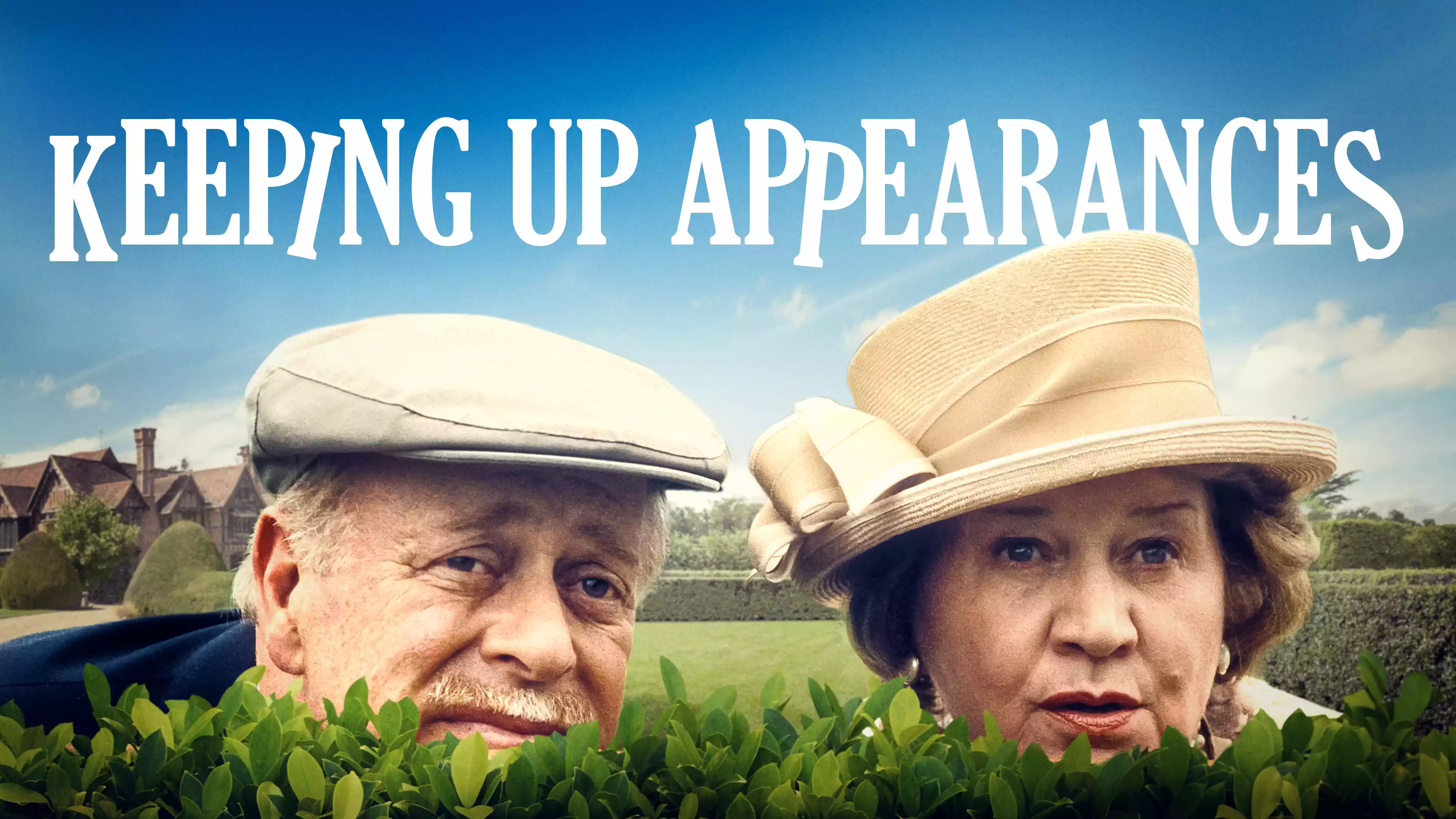
A Comedy of Manners, Delusions, and Social Climbing
Some sitcoms date themselves. Others feel locked to the moment they aired. Keeping Up Appearances is neither. First broadcast by the BBC in 1990, it remains sharply recognizable decades later, because it is not really about class in Britain so much as it is about insecurity, aspiration, and the elaborate lies people tell themselves to feel important.
At its best, Keeping Up Appearances is less a farce than a social character study, delivered with precision timing and ruthless politeness.
The Premise: Respectability as Performance
The series centers on Hyacinth Bucket, a woman obsessed with climbing the social ladder. Or, more accurately, obsessed with being seen as already having climbed it. She insists her surname is pronounced “Bouquet,” hosts candlelight suppers no one wants to attend, and introduces her modest suburban life as though it were an extension of royal society.
Hyacinth’s world is a carefully curated illusion. Everything from her china to her conversation is chosen to project refinement. The comedy comes from how fragile this projection is, and how little cooperation she gets from reality.
Her husband Richard, long-suffering and perpetually anxious, acts as both accomplice and victim. He enables her fantasies just enough to keep the peace, while privately praying that no one important answers the phone.
The show’s brilliance lies in how little actually happens. There are no sweeping story arcs or dramatic reversals. Instead, it mines humor from repetition, escalation, and inevitability. Every episode feels like watching a controlled demolition of Hyacinth’s dignity.
Hyacinth Bucket: One of Television’s Great Comic Creations
Patricia Routledge’s performance as Hyacinth is the foundation of the series. This is not a broad caricature. Hyacinth is precise, disciplined, and utterly convinced of her own superiority. Routledge plays her with musical timing and complete sincerity, which is what makes the character so effective.
Hyacinth is not cruel in a cartoon sense. She is socially aggressive, emotionally oblivious, and relentless. She talks at people, not with them. She weaponizes etiquette. She mistakes persistence for charm. These traits are exaggerated, but not invented.
Crucially, the show never invites the audience to pity her. Hyacinth is funny because she is indefatigable. Shame never sticks. Embarrassment rolls off her like rain. She resets after every humiliation and marches forward, bouquet firmly in hand.
The Supporting Cast: A Perfectly Uncooperative World
Hyacinth would not work without resistance, and Keeping Up Appearances surrounds her with people who undermine her at every turn.
Richard Bucket
Clive Swift plays Richard as a man whose spine has been worn down by decades of social crisis management. His nervous energy grounds the show. He understands exactly how absurd his wife is, but also understands that opposing her directly is pointless.
Richard’s comedy is reactive. He winces, deflects, apologizes, and survives. He is the audience surrogate, trapped in Hyacinth’s version of reality.
Daisy and Onslow
Hyacinth’s sister Daisy and brother-in-law Onslow are everything she is desperate not to be associated with. Daisy is loud, unfiltered, and cheerfully tacky. Onslow lives in a stained vest, surrounded by broken cars and dogs, and appears immune to embarrassment.
Played by Judy Cornwell and Geoffrey Hughes, the pair serve as a constant threat to Hyacinth’s self-image. Their mere existence destabilizes her narrative of genteel superiority.
What makes them effective is that they are not malicious. They simply do not care. Their comfort with themselves is the quiet punchline to Hyacinth’s constant striving.
Rose
Hyacinth’s other sister, portrayed by Shirley Stelfox and later Mary Millar, is eternally romantic, perpetually involved with “a gentleman friend,” and blissfully scandalous.
Rose embodies a different kind of rebellion. She does not chase respectability; she ignores it entirely.
Elizabeth and Emmet
Poor Elizabeth, played by Josephine Tewson, exists mainly to be cornered by Hyacinth. Their forced friendship is one of the show’s most reliable setups. Elizabeth’s polite terror whenever Hyacinth approaches is comedy built on social obligation.
Her brother Emmet, an amateur musician, adds another layer of mortification, especially when his creative endeavors collide with Hyacinth’s need for the spotlight.
Politeness as Weaponry
Created and written by Roy Clarke, the show uses formality as both subject and structure. Dialogue is meticulously polite, even when it is openly hostile. Insults are indirect. Power plays happen through invitations, seating arrangements, and telephone calls.
Much of the humor depends on rhythm and repetition. Catchphrases are not lazy here; they function like pressure points. Hyacinth’s insistence on “the Royal Doulton with the hand-painted periwinkles” is funny because it never stops being said.
The scripts trust the audience. There is no mugging for laughs, no explanatory dialogue. If you understand why a situation is awkward, the show rewards you. If you do not, it does not slow down to help.
Class Satire Without Sentimentality
It would be easy to misread Keeping Up Appearances as a simple class comedy, but it is more precise than that. Hyacinth is not poor trying to be rich. She is comfortable trying to be important.
The show skewers the idea that manners equal morality, that taste equals worth, and that proximity to power confers legitimacy. Hyacinth worships institutions she will never access, and the show never suggests she deserves to.
At the same time, it does not romanticize her opposites. Daisy and Onslow are not secretly noble. They are just content. The contrast is the point.
Longevity and Global Appeal
The series ran for five seasons and numerous specials, ending in 1995. It has since been broadcast endlessly around the world, particularly on public television in the United States, where it found an audience that immediately recognized the character type.
Hyacinth exists everywhere. She simply changes accent.
The show’s restraint helps it age well. There are few topical jokes. Technology barely intrudes. Most conflicts are interpersonal and timeless. Social anxiety, aspiration, and self-delusion do not expire.
Why It Still Works
Keeping Up Appearances endures because it understands its central character completely and never betrays that understanding. It does not soften Hyacinth. It does not punish her either. It simply lets her be herself, over and over, in a world that refuses to cooperate.
That consistency is rare. It requires confidence in both writing and performance. The result is a sitcom that feels finished, deliberate, and remarkably intact decades later.
This is not comfort television in the cozy sense. It is sharper than that. But it is deeply familiar, and in that familiarity lies its lasting power.