
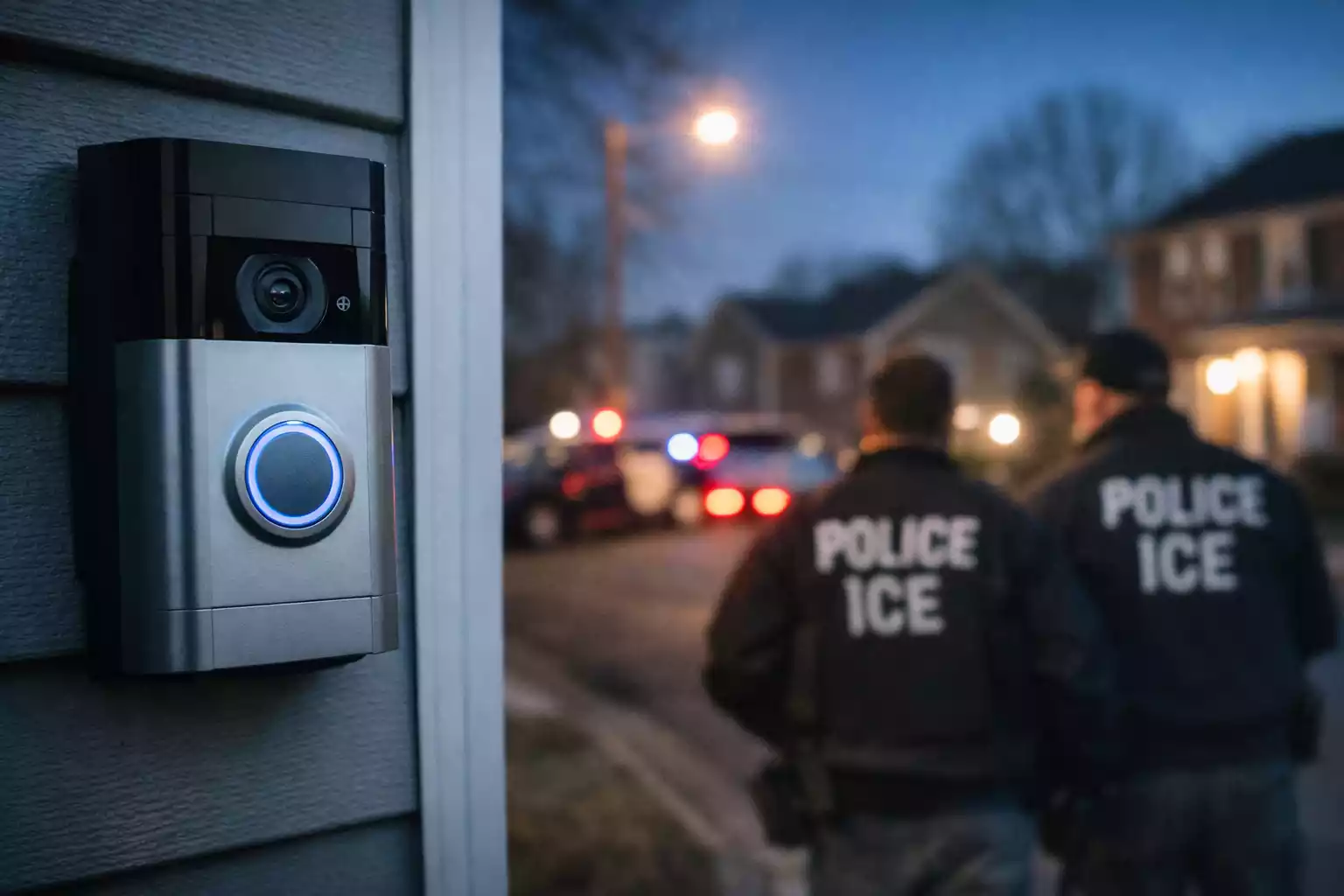
The sales pitch is safety. The fine print is access. Somewhere between a package alert and a porch pirate clip, a quiet shift has taken place in how residential cameras intersect with federal enforcement.
Neighborhood security cameras, especially those produced by Ring, have become a convenient source of footage for law enforcement. That includes U.S. Immigration and Customs Enforcement. While the company says participation is voluntary and governed by requests, the practical effect is a widening, semi-private surveillance web that reaches well beyond the homeowner who bought a doorbell.
How a doorbell became infrastructure
Ring popularized a simple idea: a connected camera at the front door, paired with an app and a neighborhood feed. Over time, two features mattered more than the hardware:
- Centralization of footage in a cloud account.
- Frictionless sharing through in-app requests and local alerts.
When police departments began partnering with Ring, the system offered an easy path to ask residents for clips. The same pathway applies to federal agencies. Requests do not require warrants in every instance, and homeowners often comply without fully understanding how the footage may be used or retained.
Ring’s ownership by Amazon added scale. Storage, distribution, and tooling matured quickly. What remained murky was oversight.
What ICE actually gets
ICE does not tap a live feed of every Ring camera. The reality is more procedural and, in some ways, more concerning.
- Request-based access: Agents ask for footage from specific dates and locations.
- Voluntary compliance: Homeowners choose to share, often prompted by official-looking notices.
- No direct notice to subjects: People recorded are not informed their image was shared.
- Unclear retention: Once shared, footage can be copied, stored, and analyzed.
In immigration enforcement, where presence in a place can be enough to trigger action, routine neighborhood video becomes a powerful locator tool.
The consent problem
The homeowner consents. The neighbors do not.
Front-facing cameras capture sidewalks, yards, visitors, delivery workers, and anyone passing through. Consent collapses into a single decision made by the device owner, even though the data describes many others. That imbalance matters when the recipient is a federal agency with detention authority.
The system relies on social pressure as much as policy. Requests are framed as helping keep the area safe. Declining can feel antisocial, even risky.

Chilling effects in real communities
Reports from immigrant advocacy groups describe predictable changes in behavior once residents believe cameras are feeding enforcement:
- Fewer people attending community events.
- Avoidance of certain blocks or apartment entrances.
- Reduced willingness to report crimes or act as witnesses.
Security technology meant to deter theft begins to reshape daily movement. That is not a side effect. It is the outcome of surveillance that extends beyond its original scope.
Corporate distance, public consequences
Ring states it does not provide blanket access to law enforcement and that users control sharing. That framing narrows responsibility to the last click. It avoids harder questions about design choices that encourage compliance, normalize sharing, and make refusal awkward.
A platform can be neutral in policy and still directional in practice.
Legal gray areas that stay gray
There is no comprehensive federal law governing how private residential footage may be requested, shared, or reused by immigration authorities. Fourth Amendment protections hinge on expectations of privacy, and courts have long treated what is visible from public space as fair game.
Doorbell cameras extend that logic by permanence. They remember what a passerby cannot.
What accountability would look like
Meaningful limits would require changes that do not currently exist:
- Clear warrants for federal access, not informal requests.
- Mandatory notice to people whose images are shared.
- Short, enforceable retention limits.
- Opt-in systems that default to non-sharing.
- Independent audits of law enforcement requests.
Without those guardrails, the system functions as a distributed surveillance layer, assembled camera by camera, consent by consent.
Why this matters now
Immigration enforcement already operates with broad discretion and limited transparency. Adding a neighborhood camera network amplifies that power while keeping it out of public view. The result is enforcement by convenience rather than by standard.
A doorbell should not double as a federal sensor. Yet that is where the current path leads, quietly, with no single switch to turn it off.